|
 |
 |
 |
 |
 |
 |
 |
 |
 |

| . |  |
. |
SSWM Bio-Raptor Demonstrates Its Solvents & Rocket Pollution Solution
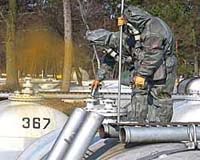
Sub-Surface Waste Management of Delaware, a subsidiary of US Microbics, recently announced it has successfully completed a full-scale, paid demonstration of its Bio-Raptor treatment system technology for the rapid cleanup of soils impacted with Perchlorates at a confidential client's former rocket fuel manufacturing facility. The company was just informed that it has been asked back to perform a second paid demonstration to treat soils impacted with both perchlorates and volatile and semi-volatile organic compounds (solvents) used as a release agent and process equipment decontamination in the manufacture of rocket fuel and flare charges. These results will be incorporated into the client's report to the oversight regulatory agency. SSWM has developed a special blend of microbes and nutrients which can rapidly degrade Perchlorates in soils within approximately a week of initial inoculation. Cleanup of perchlorates in soil and groundwater present a lucrative market opportunity in western states where Department of Defense contractors manufactured and produced various types of rocket fuels since WWII. In the United States, ammonium perchlorate is used as an oxidizer in solid rocket propellant, sodium perchlorate is used in slurry explosives and potassium perchlorate is used in road flares and air bag inflators. The US EPA has identified perchlorate users and manufacturers in 44 states and releases in 18 states, estimating that perchlorate affects the drinking water of 15 million people in the United States. Perchlorates have also recently been detected in milk and lettuce in California. Related Links US Microbics SpaceDaily Search SpaceDaily Subscribe To SpaceDaily Express  Canada Using Laser Technology To Map Industrial Plant Gases
 Edmonton - Feb 11, 2004
Alberta Research Council Inc. (ARC) scientists are seeking industry partners to test laser technology that measures emissions from flares, storage tanks, gas processing plants, feedlots and refineries. The technology, called Differential Absorption Lidar (DIAL), measure gases such as methane, sulphur dioxide, benzene and other volatile organic compounds remotely over distances up to 2 kilometres.
|
|
| |||||||||
| The content herein, unless otherwise known to be public domain, are Copyright 1995-2016 - Space Media Network. All websites are published in Australia and are solely subject to Australian law and governed by Fair Use principals for news reporting and research purposes. AFP, UPI and IANS news wire stories are copyright Agence France-Presse, United Press International and Indo-Asia News Service. ESA news reports are copyright European Space Agency. All NASA sourced material is public domain. Additional copyrights may apply in whole or part to other bona fide parties. Advertising does not imply endorsement, agreement or approval of any opinions, statements or information provided by Space Media Network on any Web page published or hosted by Space Media Network. Privacy Statement All images and articles appearing on Space Media Network have been edited or digitally altered in some way. Any requests to remove copyright material will be acted upon in a timely and appropriate manner. Any attempt to extort money from Space Media Network will be ignored and reported to Australian Law Enforcement Agencies as a potential case of financial fraud involving the use of a telephonic carriage device or postal service. |