|
 |
 |
 |
 |
 |
 |
 |
 |
 |

| . |  |
. |
Bush To Push Back Horizon For US Space Policy
President George W. Bush said he will set out the "new horizons" of US space policy on Wednesday when he is to announce a return to the moon. But questions have already been raised about the motivations behind such an endeavor, its scientific and economic benefits and how it will be financed. Speaking on the sidelines of the Americas summit in Mexico on Tuesday, Bush would not give details of his plan, but said: "The spirit is going to be one of continued exploration and seeking new horizons and investing in a program that meets that objective." Critics of the initiative, particularly in Congress, have faulted the government for a lack of vision in the space program after the Columbia disaster last February 1 when the space shuttle broke apart on re-entering the Earth's atmosphere killing all seven astronauts on board. The ambitious project to establish a training base on the moon that can serve as a launch pad for farther-reaching missions to Mars and elsewhere, is also seen a clever way of announcing plans to phase out the space shuttle by around 2010. The end of the shuttle era is a touchy subject in Florida and Texas, where the space program provides hundreds of thousands of jobs. The two southern states are vital for Bush's re-election campaign, as well as for Republicans, which hold the majority in both houses of Congress. By 2010, the space shuttle should have completed all the tasks required to get the International Space Station running, opening the way for new space travel, including an orbital space plane currently being studied, which could ferry crews to the space station, while traditional rockets would transport cargo. A prototype plane could be ready by 2008, and could be later adapted for longer voyages to the moon and Mars, NASA officials have said. But one of the moon mission's biggest protagonists, Space Frontier Foundation founder Rick Tumlinson, expressed doubts about the National Aeronautics and Space Administration's capacity to meet the challenge Bush is about to thrust upon it. "It will never get cheaper if the government stays in control," he said. "What I'm afraid of is they'll go to the moon, lock everybody else out, and NASA will run the show." Still, the potential scientific and economic dividends of lunar exploration are significant. "By 2050, approximately 10 billion people will live on Earth, demanding five times the power now available. By then, solar power from the moon could provide everyone clean, affordable and sustainable electrical power needs," David Criswell, a physics professor at the University of Houston in Texas, said at a Senate hearing in November. For Criswell, the author of three works on lunar exploration, "no terrestrial option can provide the needed minimum of at least 20 terawatts globally" that will be necessary in nearly 50 years. The cost of such a project remains to be seen, but Congress rejected a similar proposal by Bush's father, former president George Bush, in 1989, which could have cost some 400 billion dollars. This time, Bush will have to promise budgetary discipline, limiting NASA's annual budget increase to a mere five percent of its current budget of 15 billion dollars -- or nearly 800 million dollars -- requiring some belt-tightening in other space programs deemed to be less of a priority. All rights reserved. � 2004 Agence France-Presse. Sections of the information displayed on this page (dispatches, photographs, logos) are protected by intellectual property rights owned by Agence France-Presse. As a consequence, you may not copy, reproduce, modify, transmit, publish, display or in any way commercially exploit any of the content of this section without the prior written consent of Agence France-Presse. Related Links SpaceDaily Search SpaceDaily Subscribe To SpaceDaily Express  Getting Man Back To Luna Let Alone Mars Will Need More Than Rhetoric
 Paris (AFP) Jan 10, 2004
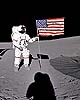
If George W. Bush, in an announcement likely to be made next Wednesday, intends to put an American on Mars, the endeavour will require commitment that endures way beyond his presidency, a gamble on technology and buckets of dollars. These factors will determine if the expected plan will enjoy the same glory as John F. Kennedy's 1961 pledge to place an American on the Moon by 1970 -- or whether history will dismiss it as a political flourish in an election year.
|
|
| |||||||||
| The content herein, unless otherwise known to be public domain, are Copyright 1995-2016 - Space Media Network. All websites are published in Australia and are solely subject to Australian law and governed by Fair Use principals for news reporting and research purposes. AFP, UPI and IANS news wire stories are copyright Agence France-Presse, United Press International and Indo-Asia News Service. ESA news reports are copyright European Space Agency. All NASA sourced material is public domain. Additional copyrights may apply in whole or part to other bona fide parties. Advertising does not imply endorsement, agreement or approval of any opinions, statements or information provided by Space Media Network on any Web page published or hosted by Space Media Network. Privacy Statement All images and articles appearing on Space Media Network have been edited or digitally altered in some way. Any requests to remove copyright material will be acted upon in a timely and appropriate manner. Any attempt to extort money from Space Media Network will be ignored and reported to Australian Law Enforcement Agencies as a potential case of financial fraud involving the use of a telephonic carriage device or postal service. |