|
 |
 |
 |
 |
 |
 |
 |
 |
 |

| . |  |
. |
Scientists Create Nanostructures
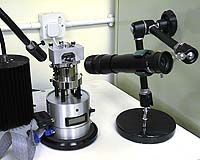
German scientists say they've found combining a scanning tunneling microscope and atoms bound to a surface can create nanostructures. Francesca Moresco and colleagues at Freie University in Berlin said the interaction between the tip of a STM and atoms or molecules bound to a surface can be used to construct impressive nanostructures, such as the quantum corral. The researchers said they combined STM manipulation techniques with the ability of a molecule to assemble nanostructures by sucking up and depositing atoms where needed. The invention of the STM during the early 1980s was the catalyst of the nanoscale technological revolution, not only for imaging, but also for interacting with matter at the atomic scale, the researchers said. Since then, progress in manipulation techniques has shown that the interaction of molecules with the surface of a metal can induce surface reconstruction. Moresco and colleagues say they go a step further by moving and organizing metal atoms on a substrate with the help of a well-designed six-leg organic molecule. The research is detailed in the in the December issue of Nature Materials. All rights reserved. � 2005 United Press International. Sections of the information displayed on this page (dispatches, photographs, logos) are protected by intellectual property rights owned by United Press International.. As a consequence, you may not copy, reproduce, modify, transmit, publish, display or in any way commercially exploit any of the content of this section without the prior written consent of United Press International. Related Links Freie University SpaceDaily Search SpaceDaily Subscribe To SpaceDaily Express  More Funds On Nano Risk Needed
 New York (UPI) Nov 18, 2005
Investigations of the environmental and health implications of nanotechnology are so important that industry and environmentalist groups, normally thought of as opposed toward each other, both told Congress they would support redirecting existing nanotechnology research funds toward such work.
|
|
| |||||||||
| The content herein, unless otherwise known to be public domain, are Copyright 1995-2016 - Space Media Network. All websites are published in Australia and are solely subject to Australian law and governed by Fair Use principals for news reporting and research purposes. AFP, UPI and IANS news wire stories are copyright Agence France-Presse, United Press International and Indo-Asia News Service. ESA news reports are copyright European Space Agency. All NASA sourced material is public domain. Additional copyrights may apply in whole or part to other bona fide parties. Advertising does not imply endorsement, agreement or approval of any opinions, statements or information provided by Space Media Network on any Web page published or hosted by Space Media Network. Privacy Statement All images and articles appearing on Space Media Network have been edited or digitally altered in some way. Any requests to remove copyright material will be acted upon in a timely and appropriate manner. Any attempt to extort money from Space Media Network will be ignored and reported to Australian Law Enforcement Agencies as a potential case of financial fraud involving the use of a telephonic carriage device or postal service. |