|
 |
 |
 |
 |
 |
 |
 |
 |
 |

| . |  |
. |
Sharp-Eyed Satellite Experiment Will Meet Immediate Air Force Demand
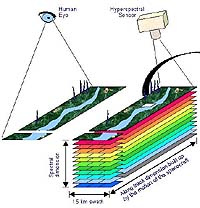
A "quick reaction" space optical payload with the potential to spot hidden targets is in development by Raytheon Company under terms of a $14-million contract awarded by the Air Force Research Laboratory's Space Vehicle Directorate. The ARTEMIS (Advanced Responsive Tactically Effective Military Imaging Spectrometer) program calls for Raytheon Space and Airborne Systems (SAS) to design and build a payload known as a hyper-spectral imaging sensor within 15 months as part of a rapid development experiment. "The intent of the program is to help demonstrate the feasibility of the 'responsive-space' concept," said Dave Shingledecker, vice president for Strategic Systems. "Satellites would be launched on demand when needed, versus the current practice of maintaining an expensive fleet of long-life satellites in orbit." In the responsive-space approach, satellites and their cargo would be kept in readiness in a holding facility where systems could be assembled and transported rapidly to a convenient launch site. "Conceivably, a system could be mounted on a satellite, launched and in orbit some 200 miles above Earth within three to seven days of a request by a field commander," Shingledecker said. Raytheon plans to employ commercial-off-the-shelf components and industry standard interfaces extensively in developing the system. "We expect this approach will lead to an order-of-magnitude reduction in overall space mission costs," Shingledecker said. Related Links Raytheon SpaceDaily Search SpaceDaily Subscribe To SpaceDaily Express  BAE SYSTEMS To Provide Geopositioning Software for DoD Applications
 San Diego CA (SPX) Jun 07, 2005
BAE Systems will provide precision geopositioning software for Department of Defense applications under the U.S. Navy's Common Geopositioning Services Project (CGSP). The contract, awarded by the Naval Air Warfare Center, is valued at $4.6 million and includes options through 2008.
|
|
| |||||||||
| The content herein, unless otherwise known to be public domain, are Copyright 1995-2016 - Space Media Network. All websites are published in Australia and are solely subject to Australian law and governed by Fair Use principals for news reporting and research purposes. AFP, UPI and IANS news wire stories are copyright Agence France-Presse, United Press International and Indo-Asia News Service. ESA news reports are copyright European Space Agency. All NASA sourced material is public domain. Additional copyrights may apply in whole or part to other bona fide parties. Advertising does not imply endorsement, agreement or approval of any opinions, statements or information provided by Space Media Network on any Web page published or hosted by Space Media Network. Privacy Statement All images and articles appearing on Space Media Network have been edited or digitally altered in some way. Any requests to remove copyright material will be acted upon in a timely and appropriate manner. Any attempt to extort money from Space Media Network will be ignored and reported to Australian Law Enforcement Agencies as a potential case of financial fraud involving the use of a telephonic carriage device or postal service. |