|
 |
 |
 |
 |
 |
 |
 |
 |
 |

| . |  |
. |
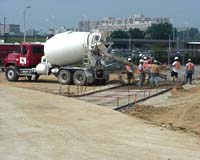
Microbes Eat Their Way To Better Concrete
Two South Dakota School of Mines and Technology researchers are creating living organisms that may provide a better way to seal cracks in concrete. Dr. Sookie Bang, professor, Department of Chemistry and Chemical Engineering, and Dr. Venkataswamy Ramakrishnan, distinguished professor emeritus, Department of Civil and Environmental Engineering, are conducting the research. The two recently were awarded $51,601 in additional funding from the National Science Foundation to continue their work. This is the second of a three-year project. During the current funding cycle, Bang and Ramakrishnan plan to develop genetically engineered microorganisms that can produce excess amounts of organic and inorganic biosealant. "This microbial sealant is a smart material that is environmentally safer and economically more feasible than the currently available synthetic sealing materials," Bang said. "Our innovative approach introduces cutting-edge biotechnology in concrete crack remediation." The microbes seal concrete surface cracks with their metabolic byproducts. That's already been done, so Bang and Ramakrishnan plan to use genetic engineering to create microbes that produce even more metabolic byproducts. The researchers will put the microbes through a wide range of concrete performance tests to measure the endurance and resistance of the repaired concrete to environmental changes. Beyond concrete reinforcement, these environmentally innocuous biological products can be used as a sealing or caulking agent for the gaps in building structures, bioremediation means to confine contaminated aquifers or subsurface soils through selective cementation, and possibly as a dust controller for surface soils. The project also provides excellent research experiences for undergraduate and graduate students who are actively involved conducting research experiments, analyzing data, presenting their findings at conferences and preparing journal publications. The research also offers potential economic development opportunities. If the research proves successful, "we will attempt to produce the microbial sealant in large scale to be commercially available in the future," Bang said. Related Links South Dakota School of Mines and Technology SpaceDaily Search SpaceDaily Subscribe To SpaceDaily Express  Space-Tech At The Paralympics
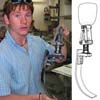 Athens, Greece (ESA) Sep 22, 2004
At the 2004 Paralympics this week, Wojtek Czyz, the world record holder for long jump, will be trusting in space technology and expertise to help him win his first Olympic medal. For the competition, parts of the prosthesis he will be using are made from material designed for space to make it both stronger and lighter.
|
|
| |||||||||
| The content herein, unless otherwise known to be public domain, are Copyright 1995-2016 - Space Media Network. All websites are published in Australia and are solely subject to Australian law and governed by Fair Use principals for news reporting and research purposes. AFP, UPI and IANS news wire stories are copyright Agence France-Presse, United Press International and Indo-Asia News Service. ESA news reports are copyright European Space Agency. All NASA sourced material is public domain. Additional copyrights may apply in whole or part to other bona fide parties. Advertising does not imply endorsement, agreement or approval of any opinions, statements or information provided by Space Media Network on any Web page published or hosted by Space Media Network. Privacy Statement All images and articles appearing on Space Media Network have been edited or digitally altered in some way. Any requests to remove copyright material will be acted upon in a timely and appropriate manner. Any attempt to extort money from Space Media Network will be ignored and reported to Australian Law Enforcement Agencies as a potential case of financial fraud involving the use of a telephonic carriage device or postal service. |