|
 |
 |
 |
 |
 |
 |
 |
 |
 |

| . |  |
. |
Solar Conjunction Period
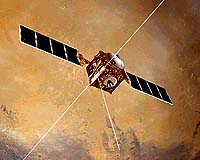
The commanding of the Mars Express routine science operations through the Payload Operations Service at RAL in the UK is proceeding well, and the corresponding planning is being performed about 10 weeks ahead of the execution of scientific activities. Currently the achieved planning covers the scientific activities to be performed up to November 2004. The first period of eclipses has ended, which allows for increased scientific payload activities on the spacecraft. The second eclipse period will start in January 2005 and extend into June 2005. The first occultation period, which was beneficial to radio science measurements, has also ended. The second occultation period will start in December 2004. The solar conjunction period is, as expected, currently severely impacting the payload activities. No payload operations are planned between 22 August and 27 September 2004, during the period affecting the spacecraft communications with the ground segment. Only solar corona measurements are being performed by the radio science experiment. Following this period, intense scientific activities will resume, with favourable operating conditions for the optical imaging instruments due to improving illumination conditions. No decision on the deployment of MARSIS has been taken yet. Upcoming Activities Around day 290 an opportunity exists to make changes to the current orbit of Mars Express. The SWT will establish the programmatic and scientific need to perform such a manoeuvre. Data Archiving Status The independent Mars Express Science Archive review was held at ESTEC on 12 and 13 July 2004. The payload teams are working towards delivering all relevant scientific products in time for the Mars Express Science Archive to be ready at the beginning of 2005. Publications The ESA SP-1240 dedicated to Mars Express - The Scientific Payload, has been published and is available on-line. Related Links Mars Express at ESA SpaceDaily Search SpaceDaily Subscribe To SpaceDaily Express  Eos Chasma, Part Of Valles Marineris
 Paris (ESA) Aug 31, 2004
These images, taken by the High Resolution Stereo Camera (HRSC) on board ESA's Mars Express spacecraft, show the southern part of Valles Marineris, called Eos Chasma.
|
|
| |||||||||
| The content herein, unless otherwise known to be public domain, are Copyright 1995-2016 - Space Media Network. All websites are published in Australia and are solely subject to Australian law and governed by Fair Use principals for news reporting and research purposes. AFP, UPI and IANS news wire stories are copyright Agence France-Presse, United Press International and Indo-Asia News Service. ESA news reports are copyright European Space Agency. All NASA sourced material is public domain. Additional copyrights may apply in whole or part to other bona fide parties. Advertising does not imply endorsement, agreement or approval of any opinions, statements or information provided by Space Media Network on any Web page published or hosted by Space Media Network. Privacy Statement All images and articles appearing on Space Media Network have been edited or digitally altered in some way. Any requests to remove copyright material will be acted upon in a timely and appropriate manner. Any attempt to extort money from Space Media Network will be ignored and reported to Australian Law Enforcement Agencies as a potential case of financial fraud involving the use of a telephonic carriage device or postal service. |