|
 |
 |
 |
 |
 |
 |
 |
 |
 |

| . |  |
. |
Europe Gets An Eyeful Of Mars
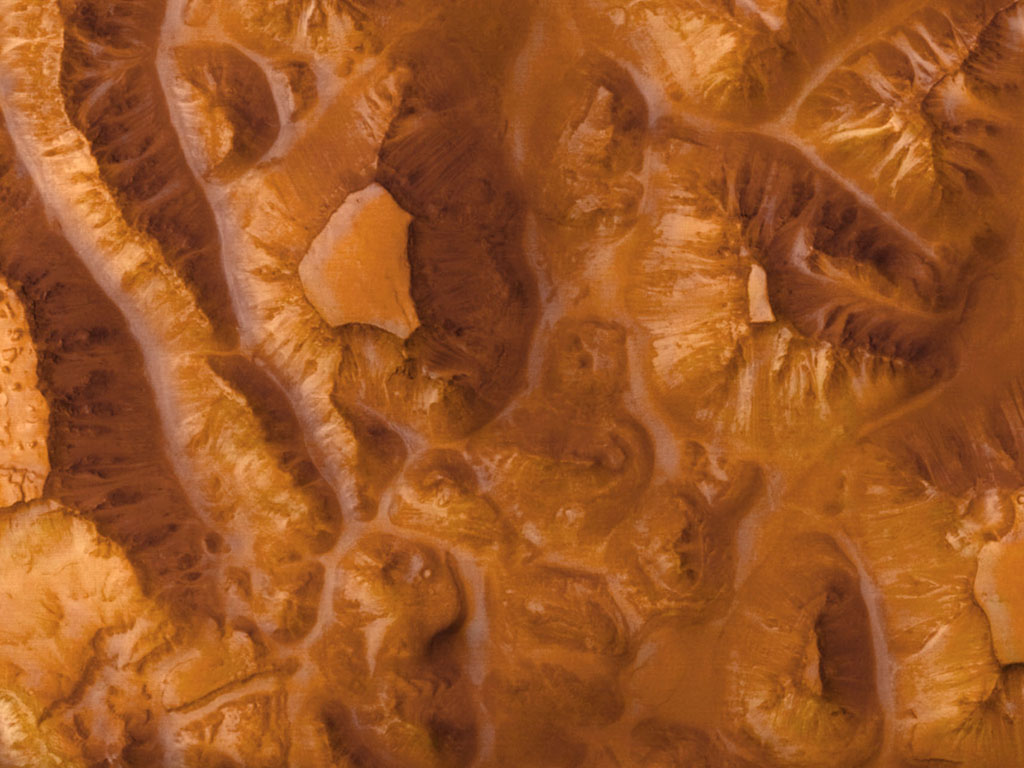
Europe's first mission to the red planet - Mars Express is now in orbit and returning stunning stereo images of Mars in brilliant color and high resolution. Following Mars Orbital Insertion last December on Christmas Day, Mars Express is about to reach its final operating orbit above the poles of the Red Planet. The scientific investigation has just started and the first results already look highly promising, as the first close-up image shows. Although the seven scientific instruments on board Mars Express are still undergoing a thorough calibration phase, they have already started collecting amazing results. The first high-resolution images and spectra of Mars have already been acquired. This first spectacular stereoscopic colour picture was taken on 14 January 2004 by ESA�s Mars Express satellite from 275 km above the surface of Mars by the High Resolution Stereo Camera (HRSC). This image is available on the ESA Portal at: http://mars.esa.int The picture shows a portion of a 1700 km long and 65 km wide swath which was taken in south-north direction across the Grand Canyon of Mars (Valles Marineris). It is the first image of this size that shows the surface of Mars in high resolution (12 metres per pixel), in colour, and in 3D. The total area of the image on the Martian surface (top left corner) corresponds to 120 000 km. The lower part of the picture shows the same region in perspective view as if seen from a low-flying aircraft. This perspective view was generated on a computer from the original image data. One looks at a landscape which has been predominantly shaped by the erosional action of water. Millions of cubic kilometres of rock have been removed, and the surface features seen now such as mountain ranges, valleys, and mesas, have been formed. The HRSC is just one of the instruments to have collected exciting data. To learn more about the very promising beginning to ESA's scientific exploration of Mars, media representatives are invited to attend a press conference on Friday, 23 January 2004, at 11:00 CET at ESA�s Space Operations Centre in Darmstadt, Germany, and in video-conference with the other ESA centres. There, under the auspices of ESA Council Chair, Germany's Minister for Education and Research, Mrs Edelgard Bulmahn, ESA's Director of the Scientific Programme, Prof. David Southwood and the Principal Investigators of all instruments on board Mars Express will present the first data and preliminary results. Also a spectacular, three-dimensional video sequence, featuring famous landmarks on the surface of Mars 'as seen through European eyes' will be unveiled for the first time on Friday 23 January. Related Links Mars at ESA SpaceDaily Search SpaceDaily Subscribe To SpaceDaily Express  Odyssey's First Look At Mars
 Pasadena - Nov 1, 2001
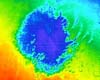
NASA's 2001 Mars Odyssey gave mission managers a real treat this Halloween with its first look at the Red Planet. It's a thermal infrared image of the Martian southern hemisphere that captures the polar carbon dioxide ice cap at a temperature of about minus 120 C (minus 184 F).
|
|
| |||||||||
| The content herein, unless otherwise known to be public domain, are Copyright 1995-2016 - Space Media Network. All websites are published in Australia and are solely subject to Australian law and governed by Fair Use principals for news reporting and research purposes. AFP, UPI and IANS news wire stories are copyright Agence France-Presse, United Press International and Indo-Asia News Service. ESA news reports are copyright European Space Agency. All NASA sourced material is public domain. Additional copyrights may apply in whole or part to other bona fide parties. Advertising does not imply endorsement, agreement or approval of any opinions, statements or information provided by Space Media Network on any Web page published or hosted by Space Media Network. Privacy Statement All images and articles appearing on Space Media Network have been edited or digitally altered in some way. Any requests to remove copyright material will be acted upon in a timely and appropriate manner. Any attempt to extort money from Space Media Network will be ignored and reported to Australian Law Enforcement Agencies as a potential case of financial fraud involving the use of a telephonic carriage device or postal service. |