|
 |
 |
 |
 |
 |
 |
 |
 |
 |

| . |  |
. |
A Fatal Martian Destiny See Part One A Fatal Design's Single Bit
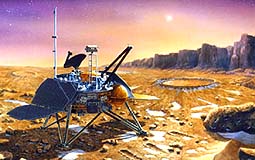
by Bruce Moomaw Cameron Park - February 16, 2000 However, during the actual Mars landing, the spacecraft would have turned off its radar at 40 meters altitude and switched over to entirely inertial guidance -- measuring its deceleration force and calculating its remaining altitude and speed from that -- and at that point it would also have begun monitoring the status of the erroneous "ground-contact" bit. As soon as it did so, it would have concluded that it had already landed and immediately switched the engines off -- falling the remining 40 meters to the surface of Mars. According to SpaceDaily's source this event has been repeatedly reproduced during the Failure Board's tests and strongly suggests that -- while we will never know for certain due to no telemetry -- it is the single most likely cause for MPL's failure. It is possible, of course, that during the actual landing this event didn't occur, and that the failure was caused by something else -- such as rugged terrain or instabilities in the thrust levels of the landing engines -- but after the Mars Observer's failure in 1993, its failure review board also could only identify the leakage of oxidizer into the craft's fuel propellant line as the single "most likely" cause of the failure, with several other causes remaining still possible. In any case, it seems likely that the MPL failure board will suggest a whole series of modifications in the design of future Mars landers to deal with all remaining possible causes of the MPL failure (as was done with Mars Observer). For example, it may perhaps recommend that future landers go back to using smoothly throttleable landing engines rather then the "pulse-modulated" system of clusters of fixed thrusters used for the first time on MPL, which might have led to a "jerky" and vibrating kind of descent braking that could have destabilized the craft. It is also possible that all future Mars landers will be equipped with obstacle avoidance systems to detect excessively rugged patches or dangerously steep slopes in the landing area, so that the lander can throttle its engines to steer sideways away from them. This writer has been told by a JPL official that, even before the MPL failure, the plan was to test such a system on the 2003 Mars Lander -- the first of the much larger and more complex landers designed to return Martian surface samples to Earth. This system -- which probably would use a scanning laser altimeter to build up a detailed 3-D map of the surface -- might simply be tested on that flight for reliability, rather than actually being hooked up to the Lander's steering system; but if it worked properly, it would definitely be used to control the next lander's autopilot in 2005. Meanwhile, the MPL Failure Review Board's final report could be officially released on Wednesday -- the same day that NASA Administrator Dan Goldin is scheduled to testify before the House Committee, at which time he will surely be asked about America's future Mars plans (although the Young Committee detailed to recommend changes to the Mars Program will not officially report until March). SpaceDaily's source also tells us that there is pressure on Goldin to request a major expansion of the "Mars Micromissions" part of the program, in which tiny spacecraft piggybacking on European Ariane 5 commercial missions would be used both to explore Mars and to set up a network of miniature communication satellites around the planet.
EARTH INVADES MARS
|
|
| ||||||||
| The content herein, unless otherwise known to be public domain, are Copyright 1995-2016 - Space Media Network. All websites are published in Australia and are solely subject to Australian law and governed by Fair Use principals for news reporting and research purposes. AFP, UPI and IANS news wire stories are copyright Agence France-Presse, United Press International and Indo-Asia News Service. ESA news reports are copyright European Space Agency. All NASA sourced material is public domain. Additional copyrights may apply in whole or part to other bona fide parties. Advertising does not imply endorsement, agreement or approval of any opinions, statements or information provided by Space Media Network on any Web page published or hosted by Space Media Network. Privacy Statement All images and articles appearing on Space Media Network have been edited or digitally altered in some way. Any requests to remove copyright material will be acted upon in a timely and appropriate manner. Any attempt to extort money from Space Media Network will be ignored and reported to Australian Law Enforcement Agencies as a potential case of financial fraud involving the use of a telephonic carriage device or postal service. |