|
 |
 |
 |
 |
 |
 |
 |
 |
 |

| . |  |
. |
Progress Inch-By-Inch For Opportunity
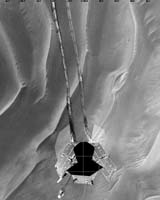
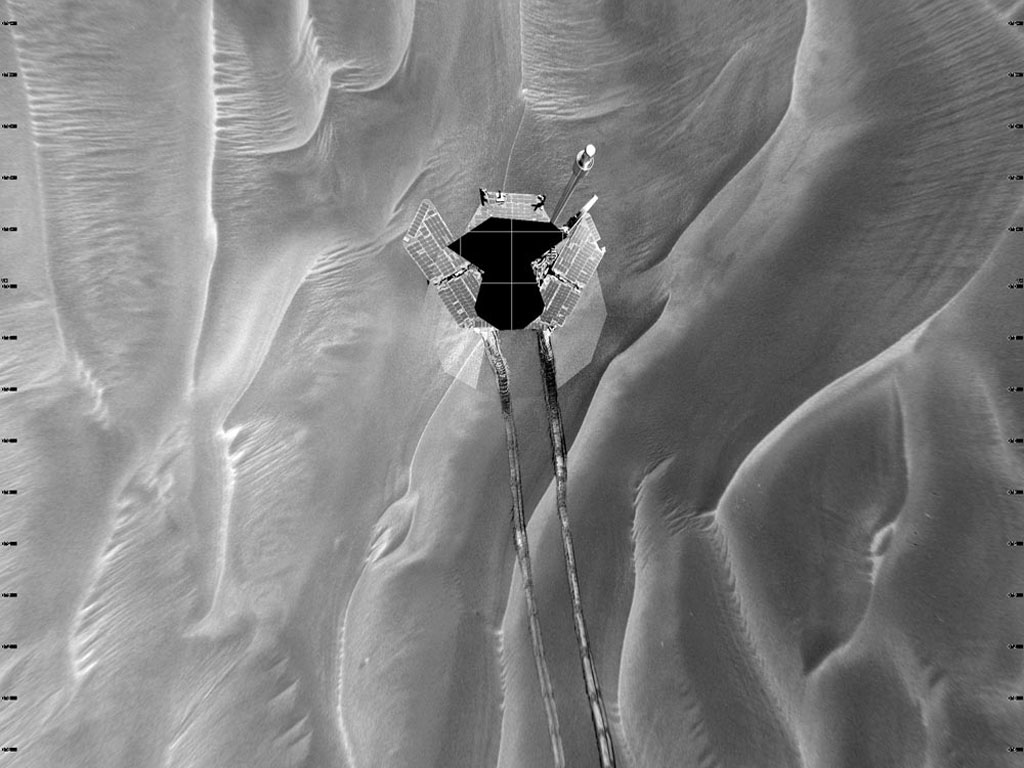
On Opportunity's first three drives to get out of the sand trap, the rover has advanced a total of 7.4 centimeters (2.9 inches) in getting off the dune. Each of the first two drives - one on sol 463 and one on sol 465 - turned the wheels about two and a half rotations, enough to drive two meters (7 feet) if there were no slippage. Images from the hazard-avoidance cameras taken during the drives show that some of caked powder adhering to wheels between cleats had come off. The team was encouraged by the results, and decided go ahead with a 4-meter (13-foot) commanded drive for sol 466.
Sol-by- sol summaries: The wheels are slipping a great deal in the sand of the dune, but the rover advanced better than anticipated from simulated tests, covering 1.9 centimeters (0.7 inch). The rover used its panoramic camera for observations of the sky and dunes. Sol 466 (May 16, 2005): Results from the sol 465 drive were good (some wheel cleats are clean and the rover is making forward progress), so the team commanded a drive that, if there were no slippage, would roll 4 meters (13 feet), consisting of ten 40-centimeter (16 inch) steps. Opportunity gained an additional 2.7 centimeters (1.1 inch). The panoramic camera made more observations of the atmosphere and dunes. Related Links Mars Rovers at JPL Mars Rovers at Cornell SpaceDaily Search SpaceDaily Subscribe To SpaceDaily Express  Opportunity Turns Its Wheels
 Ithica CA (JPL) May 17, 2005
The Mars Rover teams have contunied their slow and methodical approach to getting their 400 million dollar robots out of a sand dune on Mars some 191 million kilometers away.
|
|
| |||||||||
| The content herein, unless otherwise known to be public domain, are Copyright 1995-2016 - Space Media Network. All websites are published in Australia and are solely subject to Australian law and governed by Fair Use principals for news reporting and research purposes. AFP, UPI and IANS news wire stories are copyright Agence France-Presse, United Press International and Indo-Asia News Service. ESA news reports are copyright European Space Agency. All NASA sourced material is public domain. Additional copyrights may apply in whole or part to other bona fide parties. Advertising does not imply endorsement, agreement or approval of any opinions, statements or information provided by Space Media Network on any Web page published or hosted by Space Media Network. Privacy Statement All images and articles appearing on Space Media Network have been edited or digitally altered in some way. Any requests to remove copyright material will be acted upon in a timely and appropriate manner. Any attempt to extort money from Space Media Network will be ignored and reported to Australian Law Enforcement Agencies as a potential case of financial fraud involving the use of a telephonic carriage device or postal service. |