|
 |
 |
 |
 |
 |
 |
 |
 |
 |

| . |  |
. |
Laser To Be Used To Analyze Mars' Soil
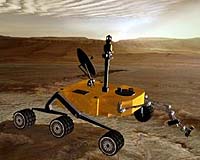
Los Alamos National Laboratory scientists say they plan to use lasers on Martian soil to help speed the search for life and water on that planet. In 2009, NASA plans to launch the Mars Science Laboratory, a rover lander equipped with a high-powered laser, capable of vaporizing the top millimeter of Martian surfaces, the Albuquerque Journal reported Thursday. Called the "ChemCam," the instrument combines a laser and a telescope to determine the chemical makeup of Martian surfaces. Roger Wiens, the principal Los Alamos scientist in charge of the instrument, told the Journal the laser's beam - with a 30-foot range - will excite and dislodge atoms from rocky and dusty surfaces. As the atoms return to their normal energy levels, they will emit a bright spark of light. The telescope, he explained, will collect the light and divide it into the composite wavelengths - some of which are beyond the visible spectrum - to determine what elements make up various Martian rock and dust samples. The technique is expected to substantially increase the speed at which scientists on Earth can analyze the Martian surface for signs of life and water. All rights reserved. � 2005 United Press International. Sections of the information displayed on this page (dispatches, photographs, logos) are protected by intellectual property rights owned by United Press International. As a consequence, you may not copy, reproduce, modify, transmit, publish, display or in any way commercially exploit any of the content of this section without the prior written consent of United Press International. Related Links SpaceDaily Search SpaceDaily Subscribe To SpaceDaily Express  Life Detection Instrument Passes Key Test On Road To Mars
 Berkeley CA (SPX) Jun 29, 2005
The dry, dusty, treeless expanse of Chile's Atacama Desert is the most lifeless spot on the face of the Earth, and that's why Alison Skelley and Richard Mathies joined a team of NASA scientists there earlier this month.
|
|
| |||||||||
| The content herein, unless otherwise known to be public domain, are Copyright 1995-2016 - Space Media Network. All websites are published in Australia and are solely subject to Australian law and governed by Fair Use principals for news reporting and research purposes. AFP, UPI and IANS news wire stories are copyright Agence France-Presse, United Press International and Indo-Asia News Service. ESA news reports are copyright European Space Agency. All NASA sourced material is public domain. Additional copyrights may apply in whole or part to other bona fide parties. Advertising does not imply endorsement, agreement or approval of any opinions, statements or information provided by Space Media Network on any Web page published or hosted by Space Media Network. Privacy Statement All images and articles appearing on Space Media Network have been edited or digitally altered in some way. Any requests to remove copyright material will be acted upon in a timely and appropriate manner. Any attempt to extort money from Space Media Network will be ignored and reported to Australian Law Enforcement Agencies as a potential case of financial fraud involving the use of a telephonic carriage device or postal service. |