|
 |
 |
 |
 |
 |
 |
 |
 |
 |

| . |  |
. |
Kazakhs, Russians Create Space Venture
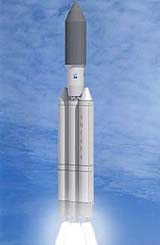
Russia and Kazakhstan have signed founding documents for a joint space venture, Russian space officials said Tuesday. Alexander Medvedev, head of the Khrunichev State Space Research and Production Center, and Maksudbek Rakhanov, chairman of the Kazakh Finance Ministry's State Property and Privatization Committee, signed the founding documents for the Baiterek joint venture, Khrunichev said in a news release. Each nation retains a 50 percent share in the venture with a charter capital of $400,000, the Kazinform news agency said. Khrunichev will build a new rocket-launch complex for Angara boosters - Russian heavy launch vehicles - at Kazakhstan's Baikonur cosmodrome, the center said. Baiterek's infrastructure will be based on existing launch sites for heavy boosters. The center will be named Baiterek and planned for completion by the en d of 2008, Russian media reported earlier. Kazakhstan's share of the project will total between $120 million and $150 million, the Interfax-Kazakhstan news agency said. International Launch Services, a joint venture of U.S. Lockheed Martin and Khrunichev, will market Baiterek's services, Khrunichev said. The Baikonur cosmodrome - 330 miles southwest of the Kazakh capital of Astana - is now leased from Kazakhstan by the Russian government.
Russia And Kazakhstan To Build Commercial Rocket The rocket will be built at Russia's Baikonur space base in Kazakhstan. "We have established a joint venture to develop a new rocket, Baitarek, based on the Russian (military) rocket Angara," said General Anatoly Perminov of the Russian space agency Roskosmos. He said the project would be financed by Kazakhstan. "It will be used solely for civilian purposes," Viatcheslav Davidenko, a Roskosmos spokesman, told AFP. "Russia will develop the two projects, Baitarek and Angara, simultaneously," he added. The Baiterek project will cost up to 200 million dollars, another Roskosmos employee said on condition of anonymity. The Angara project will mainly be used to put Russian military satellites in space and should replace the powerful rocket currently used, the Proton. It is scheduled for completion in 2008 at the Plessetsk space station in Russia's northwest. Unlike the Proton, which uses a toxic fuel, both Baitarek and Angara will be powered by a cleaner fuel mixture of liquid oxygen and kerosene. All rights reserved. � 2005 Agence France-Presse. Sections of the information displayed on this page (dispatches, photographs, logos) are protected by intellectual property rights owned by Agence France-Presse. As a consequence, you may not copy, reproduce, modify, transmit, publish, display or in any way commercially exploit any of the content of this section without the prior written consent of Agence France-Presse. Related Links SpaceDaily Search SpaceDaily Subscribe To SpaceDaily Express  LockMart Delivers Atlas V For NASA's Mars Reconnaissance Orbiter Mission
 Denver CO (SPX) Apr 05, 2005
The National Aeronautics and Space Administration (NASA), Jet Propulsion Laboratory and Lockheed Martin mark another significant milestone in the Mars space exploration program as Lockheed Martin delivered the vehicle that will launch the Mars Reconnaissance Orbiter mission to Mars.
|
|
| |||||||||
| The content herein, unless otherwise known to be public domain, are Copyright 1995-2016 - Space Media Network. All websites are published in Australia and are solely subject to Australian law and governed by Fair Use principals for news reporting and research purposes. AFP, UPI and IANS news wire stories are copyright Agence France-Presse, United Press International and Indo-Asia News Service. ESA news reports are copyright European Space Agency. All NASA sourced material is public domain. Additional copyrights may apply in whole or part to other bona fide parties. Advertising does not imply endorsement, agreement or approval of any opinions, statements or information provided by Space Media Network on any Web page published or hosted by Space Media Network. Privacy Statement All images and articles appearing on Space Media Network have been edited or digitally altered in some way. Any requests to remove copyright material will be acted upon in a timely and appropriate manner. Any attempt to extort money from Space Media Network will be ignored and reported to Australian Law Enforcement Agencies as a potential case of financial fraud involving the use of a telephonic carriage device or postal service. |