|
 |
 |
 |
 |
 |
 |
 |
 |
 |

| . |  |
. |
Last Boeing Delta 2 For 2001 Will Launch An Argonaut
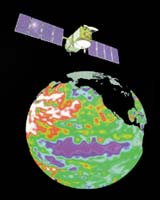
A Boeing Delta rocket is poised to thunder into the skies over Vandenberg Air Force Base, Calif., to launch NASA's Jason-1 and TIMED spacecraft. The launch, scheduled for 7:07 a.m. PST on Dec. 7, 2001 from Space Launch Complex 2W, will be the last of seven Boeing Delta launches this year. "This mission illustrates the continuing Delta legacy," said Joy Bryant, Boeing director of NASA expendable launch programs. "We've come a long way because of our commitment to success. "We will again demonstrate that commitment to ensure that Jason-1 and TIMED satellites safely reach their proper orbits." For this mission, the rocket will feature a 10-foot composite fairing and a dual-payload attach fitting for deployment. Jason-1 is a mission to monitor global ocean circulation, study the link between the oceans and atmosphere, improve global climate predictions and monitor events such as El Nino. Jason-1 is a joint effort between NASA's Jet Propulsion Laboratory in Pasadena Calif., and the French Space Agency, CNES. TIMED, the Thermosphere Ionosphere Mesosphere Energetics and Dynamics satellite, will explore the least understood region of the Earth's atmosphere, the Mesosphere and Lower Thermosphere/Ionosphere. This mission will help scientists better understand this atmospheric region's effects on a number of areas including communications, satellite tracking and spacecraft lifetimes. TIMED is a joint effort between NASA's Goddard Space Flight Center located in Greenbelt, Md., and the Johns Hopkins University Applied Physics Laboratory in Laurel, Md. This year, Boeing has already successfully launched a Global Positioning System (GPS) satellite for the U.S. Air Force, an advanced technology demonstration satellite called GeoLITE for National Reconnaissance Office, NASA's Mars Odyssey, MAP and Genesis spacecraft, and the world's most advance digital imaging satellite, DigitalGlobe's Quickbird. Related Links Jason 1 and Launch Details at SeaLevel.nasa TIMED SpaceDaily Search SpaceDaily Subscribe To SpaceDaily Express  Jason 1: The 21st Century Argonaut
 Pasadena July 31, 2001
The Jason 1 satellite, a joint project of NASA and CNES, the French space agency, arrived at Vandenberg Air Force Base, Calif., today to begin final preparations for launch no earlier than Sept. 15.
|
|
| |||||||||
| The content herein, unless otherwise known to be public domain, are Copyright 1995-2016 - Space Media Network. All websites are published in Australia and are solely subject to Australian law and governed by Fair Use principals for news reporting and research purposes. AFP, UPI and IANS news wire stories are copyright Agence France-Presse, United Press International and Indo-Asia News Service. ESA news reports are copyright European Space Agency. All NASA sourced material is public domain. Additional copyrights may apply in whole or part to other bona fide parties. Advertising does not imply endorsement, agreement or approval of any opinions, statements or information provided by Space Media Network on any Web page published or hosted by Space Media Network. Privacy Statement All images and articles appearing on Space Media Network have been edited or digitally altered in some way. Any requests to remove copyright material will be acted upon in a timely and appropriate manner. Any attempt to extort money from Space Media Network will be ignored and reported to Australian Law Enforcement Agencies as a potential case of financial fraud involving the use of a telephonic carriage device or postal service. |