|
 |
 |
 |
 |
 |
 |
 |
 |
 |

| . |  |
. |
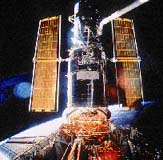
Instrument Aboard Hubble Space Telescope Suspends Operation
One of four science instruments aboard NASA's Hubble's Space Telescope suspended operations earlier this week, and engineers are now looking into possible recovery options. The instrument, called the Space Telescope Imaging Spectrograph (STIS), was installed during the second Hubble servicing mission in 1997 and was designed to operate for five years. It has either met or exceeded all its scientific requirements. Hubble's other instruments, the Near Infrared Camera and Multi-Object Spectrometer (NICMOS), the Advanced Camera for Surveys, and the Wide Field/Planetary Camera 2 are all operating normally. The STIS instrument, which went into a suspended mode Tuesday, was not slated for replacement or upgrade as part of any future servicing mission. NASA has convened an Anomaly Review Board to investigate the cause of the STIS problem and an investigation is underway to determine if the instrument is recoverable. Preliminary findings indicate a problem with the +5V DC-DC power converter on Side 2, which supplies power to the mechanism's electronics. STIS suffered a similar electrical malfunction in 2001 that rendered Side 1 inoperable. A final decision on how to proceed is expected in the coming weeks as analysis of the problem progresses. In the current observing cycle, STIS accounts for about 30 percent of all Hubble scientific observation programs. A "standby" list of peer reviewed and approved observing programs for the other science instruments on Hubble can be used to fill the observing time now available. The high sensitivity and spatial resolution of STIS enabled astronomers to search for massive black holes and study star formation, planets, nebulae, galaxies, and other objects in fine detail. STIS was developed jointly with Ball Aerospace under the direction of principal investigator Dr. Bruce E. Woodgate of the Laboratory for Astronomy and Solar Physics at NASA's Goddard Space Flight Center, Greenbelt, Md. Among the major scientific achievements made by scientists using STIS were:
Related Links Hubble at NASA SpaceDaily Search SpaceDaily Subscribe To SpaceDaily Express  Analysis Costs Could Sink Hubble Rescue
 by Phil Berardelli
Washington, (UPI) Aug 5, 2004 Ballooning costs coupled with tightening budgets threaten to overwhelm any attempt to rescue the aging and beginning-to-ail Hubble Space Telescope. The Hubble faces almost certain doom within the next five years unless NASA can dispatch a repair mission, either by a crewed shuttle flight or by an as-yet-untested robotic spacecraft.
|
|
| |||||||||
| The content herein, unless otherwise known to be public domain, are Copyright 1995-2016 - Space Media Network. All websites are published in Australia and are solely subject to Australian law and governed by Fair Use principals for news reporting and research purposes. AFP, UPI and IANS news wire stories are copyright Agence France-Presse, United Press International and Indo-Asia News Service. ESA news reports are copyright European Space Agency. All NASA sourced material is public domain. Additional copyrights may apply in whole or part to other bona fide parties. Advertising does not imply endorsement, agreement or approval of any opinions, statements or information provided by Space Media Network on any Web page published or hosted by Space Media Network. Privacy Statement All images and articles appearing on Space Media Network have been edited or digitally altered in some way. Any requests to remove copyright material will be acted upon in a timely and appropriate manner. Any attempt to extort money from Space Media Network will be ignored and reported to Australian Law Enforcement Agencies as a potential case of financial fraud involving the use of a telephonic carriage device or postal service. |