|
 |
 |
 |
 |
 |
 |
 |
 |
 |

| . |  |
. |
NASA Selects Magnetospheric Multiscale Instrument Suite Team
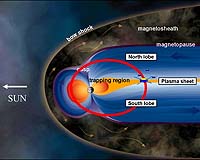
NASA has selected the Magnetospheric MultiScale (MMS) Instrument Suite team led by Dr. James L. Burch of Southwest Research Institute (SRI), San Antonio, to work with the Goddard Space Flight Center (GSFC) MMS Project in mission formulation. The proposed cost of the instrument suite for MMS mission formulation was $140 million. The MMS mission is scheduled for launch in 2013. The mission will employ four identically instrumented spacecraft to make coordinated high-resolution observations of fundamental plasma physical processes in the Earth's magnetosphere, the region in space closest to the planet. "MMS results will directly contribute to understanding the sun and its effects on Earth, the solar system, and the space environment human explorers will experience," said NASA's Deputy Associate Administrator of the Science Mission Directorate Ghassem Asrar. "Because the Earth's magnetosphere is the only accessible laboratory we have in which to study this fundamental astrophysical process, what we learn from MMS will also have broad application to our studies of the universe," he said. NASA received two proposals in response to the MMS Announcement of Opportunity. They were evaluated on scientific and technical merit and feasibility. Both proposing teams were selected to conduct a six-month implementation-feasibility study focusing on cost, management, technical plans, educational outreach and small business involvement. Based on results of these studies, NASA selected the SRI team to continue instrument suite definition in support of mission formulation activities leading to an initial confirmation review for MMS early in 2006. Related Links NASA's Solar Terrestrial Probe program Southwest Research Institute SpaceDaily Search SpaceDaily Subscribe To SpaceDaily Express  Alaskan High Schoolers Help NASA Record, Share 'Earth Music'
 Greenbelt MD (SPX) Feb 28, 2005
In the tiny town of North Pole, Alaska, the sun currently creeps into view for just three or four hours a day. Temperatures typically crash in February to minus-30 degrees Fahrenheit or lower. And bears aren't uncommon in these parts - mother grizzlies have on occasion sheltered their cubs in the woods near the local high school.
|
|
| |||||||||
| The content herein, unless otherwise known to be public domain, are Copyright 1995-2016 - Space Media Network. All websites are published in Australia and are solely subject to Australian law and governed by Fair Use principals for news reporting and research purposes. AFP, UPI and IANS news wire stories are copyright Agence France-Presse, United Press International and Indo-Asia News Service. ESA news reports are copyright European Space Agency. All NASA sourced material is public domain. Additional copyrights may apply in whole or part to other bona fide parties. Advertising does not imply endorsement, agreement or approval of any opinions, statements or information provided by Space Media Network on any Web page published or hosted by Space Media Network. Privacy Statement All images and articles appearing on Space Media Network have been edited or digitally altered in some way. Any requests to remove copyright material will be acted upon in a timely and appropriate manner. Any attempt to extort money from Space Media Network will be ignored and reported to Australian Law Enforcement Agencies as a potential case of financial fraud involving the use of a telephonic carriage device or postal service. |