|
 |
 |
 |
 |
 |
 |
 |
 |
 |

| . |  |
. |
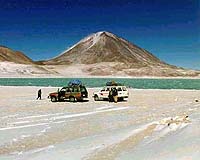
Melting Crust Makes Rich Mineral Deposits: Geologist
A University of Toronto study suggests why giant gold and copper deposits are found at some volcanoes but not others, a finding that could point prospectors to large deposits of these and other valuable metals. "There's one characteristic that is common to all of these big gold and copper deposits anywhere in the world," says Professor James Mungall of the Department of Geology. The ocean's crust that is pushed down under a volcano starts to melt, which it doesn't normally do. His study, which appears in the October issue of Geology, examines the "Rim of Fire" volcanoes that surround the Pacific Ocean. Mungall suggests that rich mineral deposits occur only when a slab of ocean floor slides underneath a continent or another part of the ocean floor and melts from the heat of the earth's interior. The slab may get stuck long enough to melt or it may scrape along almost horizontally under the volcano, melting and causing the release of the metals to produce gold or copper deposits that are close enough to the surface for mining. "These findings could help to identify regions where these rich deposits are most likely to be present," says Mungall. The research was funded by the Natural Sciences and Engineering Research Council of Canada. Related Links Geology At Toronto SpaceDaily Search SpaceDaily Subscribe To SpaceDaily Express  Earth's New Center May Be The Seed Of Our Planet's Formation
 Los Angeles - Oct 13, 2002
An odd, previously unknown sphere, some 360 miles in diameter, has been found at the bottom of the Earth. It was detected by a Harvard professor and a graduate student who patiently examined records of hundreds of thousands of earthquake waves that passed through the center of the planet in the past 30 years.
|
|
| |||||||||
| The content herein, unless otherwise known to be public domain, are Copyright 1995-2016 - Space Media Network. All websites are published in Australia and are solely subject to Australian law and governed by Fair Use principals for news reporting and research purposes. AFP, UPI and IANS news wire stories are copyright Agence France-Presse, United Press International and Indo-Asia News Service. ESA news reports are copyright European Space Agency. All NASA sourced material is public domain. Additional copyrights may apply in whole or part to other bona fide parties. Advertising does not imply endorsement, agreement or approval of any opinions, statements or information provided by Space Media Network on any Web page published or hosted by Space Media Network. Privacy Statement All images and articles appearing on Space Media Network have been edited or digitally altered in some way. Any requests to remove copyright material will be acted upon in a timely and appropriate manner. Any attempt to extort money from Space Media Network will be ignored and reported to Australian Law Enforcement Agencies as a potential case of financial fraud involving the use of a telephonic carriage device or postal service. |