|
 |
 |
 |
 |
 |
 |
 |
 |
 |

| . |  |
. |
Saturn's Filaments And Vortices
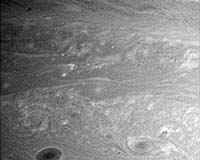
Faint filaments in Saturn's atmosphere spiral around two oval-shaped storms in a direction opposite to the winds which rotate around Southern Hemisphere hurricanes on Earth. One storm is seen near the lower right, and the other is near the lower left above a much darker storm. Atmospheric scientists do not yet fully understand what these filaments are, but some possible explanations have been proposed. The filaments might represent material connecting the spots if the two have recently split from a single storm. The spirals could also represent wind flow in the atmosphere. Further investigation by Cassini imaging scientists is likely to clarify the precise nature of the filaments. This image (top) was taken in visible light with the Cassini spacecraft narrow-angle camera on July 6, 2005, at a distance of approximately 2.4 million kilometers (1.5 million miles) from Saturn using a filter sensitive to wavelengths of infrared light centered at 750 nanometers. The image scale is 14 kilometers (9 miles) per pixel.
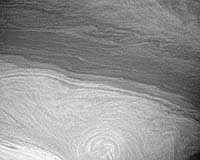
Impressions From Cassini Saturn's turbulent atmosphere is reminiscent of a Van Gogh painting in this view from Cassini. However, unlike the famous impressionist painter, Cassini records the world precisely as it appears to the spacecraft's cameras.
Counter-flowing eastward and westward jets are the dominant dynamic features seen in the giant planet atmospheres. A chevron-shaped feature with the tip pointed east means that this is a local maximum in the eastward wind and a region of horizontal wind shear, where clouds to the north and south of the jet are being swept back by the slower currents on the sides of the jet. This image (bottom) was taken in visible light with the Cassini spacecraft narrow-angle camera on July 6, 2005, at a distance of approximately 2.5 million kilometers (1.5 million miles) from Saturn using a filter sensitive to wavelengths of infrared light centered at 727 nanometers. The image scale is 14 kilometers (9 miles) per pixel. Related Links Cassini-Huygens at JPL Cassini Imaging Team SpaceDaily Search SpaceDaily Subscribe To SpaceDaily Express  Cassini Flies By Saturn's Tortured Moon Mimas
 Pasadena CA (JPL) Aug 08, 2005
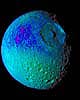
On its recent close flyby of Mimas, the Cassini spacecraft found the Saturnian moon looking battered and bruised, with a surface that may be the most heavily cratered in the Saturn system.
|
|
| ||||||||||
| The content herein, unless otherwise known to be public domain, are Copyright 1995-2016 - Space Media Network. All websites are published in Australia and are solely subject to Australian law and governed by Fair Use principals for news reporting and research purposes. AFP, UPI and IANS news wire stories are copyright Agence France-Presse, United Press International and Indo-Asia News Service. ESA news reports are copyright European Space Agency. All NASA sourced material is public domain. Additional copyrights may apply in whole or part to other bona fide parties. Advertising does not imply endorsement, agreement or approval of any opinions, statements or information provided by Space Media Network on any Web page published or hosted by Space Media Network. Privacy Statement All images and articles appearing on Space Media Network have been edited or digitally altered in some way. Any requests to remove copyright material will be acted upon in a timely and appropriate manner. Any attempt to extort money from Space Media Network will be ignored and reported to Australian Law Enforcement Agencies as a potential case of financial fraud involving the use of a telephonic carriage device or postal service. |