|
 |
 |
 |
 |
 |
 |
 |
 |
 |

| . |  |
. |
Cassini's T4 Flyby
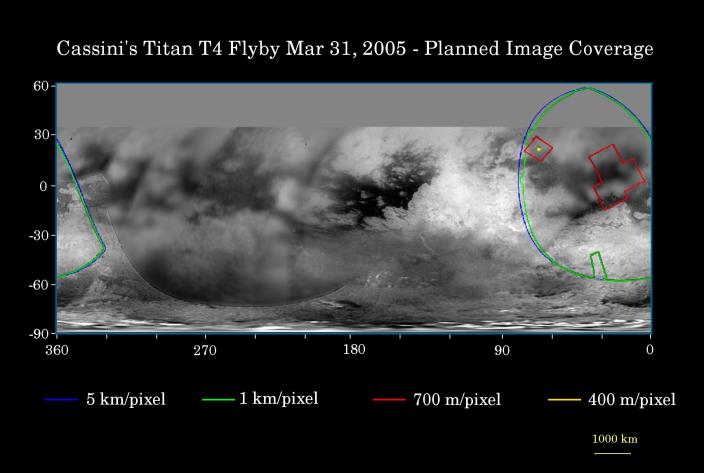
This map of Titan's surface illustrates the regions that will be imaged by Cassini during the spacecraft's close flyby of the haze-covered moon on March 31, 2005. At closest approach, the spacecraft is expected to pass approximately 2,400 kilometers (1,500 miles) above the moon's surface. The colored lines delineate the regions that will be imaged at different resolutions. Images from this encounter will include the eastern portion of territory observed by Cassini's radar instrument in October 2004 and February 2005. This will be the Cassini cameras' best view to date of this area of Titan. The higher resolution (red) box at the northwestern edge of the covered region targets the area observed by Cassini's synthetic aperture radar at the closest approach point of the February flyby. The Cassini visual and infrared mapping spectrometer experiment will also be targeting this area during the March 31 flyby, yielding coverage of the same part of Titan's surface by three different instruments. The map shows only brightness variations on Titan's surface (the illumination is such that there are no shadows and no shading due to topographic variations). Previous observations indicate that, due to Titan's thick, hazy atmosphere, the sizes of surface features that can be resolved are a few to five times larger than the actual pixel scale labeled on the map. The images for this global map were obtained using a narrow band filter centered at 938 nanometers - a near-infrared wavelength (invisible to the human eye). At that wavelength, light can penetrate Titan's atmosphere to reach the surface and return through the atmosphere to be detected by the camera. The images have been processed to enhance surface details. It is currently northern winter on Titan, so the moon's high northern latitudes are not illuminated, resulting in the lack of coverage north of 35 degrees north latitude. At 5,150 kilometers (3,200 miles) across, Titan is one of the solar system's largest moons. Related Links Cassini-Huygens at JPL Cassini Imaging Team SpaceDaily Search SpaceDaily Subscribe To SpaceDaily Express  Janus: God Of Beginnings
 Pasadena CA (JPL) Mar 29, 2005
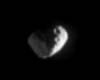
This close-up view of Saturn's moon Janus shows what appear to be two large craters near the boundary between day and night. The left side of the moon is lit feebly by reflected light from Saturn. Janus is 181 kilometers (113 miles) across.
|
|
| |||||||||
| The content herein, unless otherwise known to be public domain, are Copyright 1995-2016 - Space Media Network. All websites are published in Australia and are solely subject to Australian law and governed by Fair Use principals for news reporting and research purposes. AFP, UPI and IANS news wire stories are copyright Agence France-Presse, United Press International and Indo-Asia News Service. ESA news reports are copyright European Space Agency. All NASA sourced material is public domain. Additional copyrights may apply in whole or part to other bona fide parties. Advertising does not imply endorsement, agreement or approval of any opinions, statements or information provided by Space Media Network on any Web page published or hosted by Space Media Network. Privacy Statement All images and articles appearing on Space Media Network have been edited or digitally altered in some way. Any requests to remove copyright material will be acted upon in a timely and appropriate manner. Any attempt to extort money from Space Media Network will be ignored and reported to Australian Law Enforcement Agencies as a potential case of financial fraud involving the use of a telephonic carriage device or postal service. |