|
 |
 |
 |
 |
 |
 |
 |
 |
 |

| . |  |
. |
Getting Closer To Titan
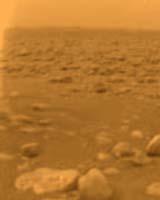
Irregular bright and dark regions of yet unidentified composition and character are becoming increasingly visible on Titan's surface as Cassini approaches its scheduled first flyby of Saturn's largest moon on July 2, 2004. This view represents an improvement in resolution of nearly three times over the previous Cassini images of Titan. Titan's surface is difficult to study, veiled by a dense hydrocarbon haze that forms in the high stratosphere as methane is destroyed by sunlight. This image is different from previous Titan images by Cassini because it was taken through a special filter, called a polarizer, which is designed to see through the atmosphere to the surface. Cassini will conduct a critical 96-minute burn before going into orbit around Saturn on June 30 (July 1 Universal Time), with its first scheduled flyby of Titan on July 2. Related Links Cassini Imaging Team Cassini at JPL SpaceDaily Search SpaceDaily Subscribe To SpaceDaily Express  Cassini VIMS Team Finds That Phoebe May Be Kin To Comets
 Pasadena (JPL) Jun 24, 2004
Scientists may at last have settled the debate on the origin of Saturn's moon, Phoebe. Saturn long ago captured its largest outermost satellite, Phoebe, when the moon wandered in from the frigid region beyond the orbit of Neptune called the Kuiper belt, they conclude.
|
|
| |||||||||
| The content herein, unless otherwise known to be public domain, are Copyright 1995-2016 - Space Media Network. All websites are published in Australia and are solely subject to Australian law and governed by Fair Use principals for news reporting and research purposes. AFP, UPI and IANS news wire stories are copyright Agence France-Presse, United Press International and Indo-Asia News Service. ESA news reports are copyright European Space Agency. All NASA sourced material is public domain. Additional copyrights may apply in whole or part to other bona fide parties. Advertising does not imply endorsement, agreement or approval of any opinions, statements or information provided by Space Media Network on any Web page published or hosted by Space Media Network. Privacy Statement All images and articles appearing on Space Media Network have been edited or digitally altered in some way. Any requests to remove copyright material will be acted upon in a timely and appropriate manner. Any attempt to extort money from Space Media Network will be ignored and reported to Australian Law Enforcement Agencies as a potential case of financial fraud involving the use of a telephonic carriage device or postal service. |