|
 |
 |
 |
 |
 |
 |
 |
 |
 |

| . |  |
. |
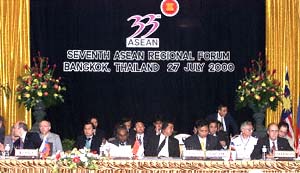
by Dan Eaton Bangkok (AFP) July 27, 2000 - Russia and India took aim at the United States at an Asian security forum here Thursday, saying its missile defence program and "Cold War mentality" threatened regional stability. Foreign ministers from the three nuclear states singled out the US Theatre Missile Defence (TMD) program for stinging attacks ahead of the arrival at the Bangkok talks of Secretary of State Madeleine Albright. "A Cold War mentality is still affecting the way some countries perceive world politics and international relations," Chinese Foreign Minister Tang Jiaxuan said in a speech at the opening session of the ASEAN Regional Forum. "Some people are hawking the Theatre Missile Defence program against the tide of our times," he said, referring to the American ballistic defence system planned for northeast Asia. "Such developments are compromising regional confidence building and aggravating the instability of regional security." His Russian counterpart Igor Ivanov fired a broadside of his own, saying US moves to develop and deploy the regional anti-missile shield and a similar national system risked sparking a new global arms race. "The US plan to develop the National Missile Defence is a matter of deep concern," he told delegates from 22 nations and the European Union, adding the TMD was equally worrying. "As a result, further strategic offensive arms reduction would become impossible and the entire system of arms reduction and limitation agreements would be revised (and) would inevitably lead to a new arms race." Indian External Affairs Minister Jaswant Singh also expressed his country's opposition, delegation spokesman Raminder Jassal told reporters. "We are against the militarisation of outer space and any steps that could lead to a cascading effect in terms of an arms race," he said. Albright's deputy Strobe Talbott, standing in for the secretary whose arrival was delayed by the Middle East peace talks, tried to deflect the criticism. "The positions of both sides are well known," he said. The ASEAN Regional Forum -- Asia's only security working group -- met here Thursday with North Korea as a member for the first time. The North's Foreign Minister Paek Nam-Sun spent much of the day in bilateral meetings and is scheduled to hold an historic meeting with Albright on Friday. North Korea has in the past warned it will increase its arms build-up to cope with a US regional missile defence system, denouncing its development as a "reckless criminal act." The US says the system is designed to protect Japan and Washington's other Asian allies from any missile attack from "rogue states," in which it includes North Korea. Other delegates Thursday also expressed opposition to the TMD program, host Thailand said. "Nobody spoke in support (of TMD), but the American representative promised to bring the sentiment, the expression of concern, back to where the decisions are being made," Thai Foreign Minister Surin Pitsuwan said. Australia, a key US ally in the region, declined to be drawn into the debate, saying it was too early for it to take a stand. "It's perfectly well known that Russia and China oppose missile defence. It is perfectly well known the US is working on this system. Everyone knows what their positions are," Alexander Downer said. ASEAN groups Brunei, Cambodia, Indonesia, Laos, Malaysia, Myanmar, the Philippines, Singapore, Thailand and Vietnam. The ARF also includes Australia, Canada, China, the European Union, India, Japan, Mongolia, New Zealand, North Korea, Papua New Guinea, Russia, South Korea, and the United States.
Copyright 2000 AFP. All rights reserved. The material on this page is provided by AFP and may not be published, broadcast, rewritten or redistributed.
SPACEWAR.COM
|
|
| |||||||||
| The content herein, unless otherwise known to be public domain, are Copyright 1995-2016 - Space Media Network. All websites are published in Australia and are solely subject to Australian law and governed by Fair Use principals for news reporting and research purposes. AFP, UPI and IANS news wire stories are copyright Agence France-Presse, United Press International and Indo-Asia News Service. ESA news reports are copyright European Space Agency. All NASA sourced material is public domain. Additional copyrights may apply in whole or part to other bona fide parties. Advertising does not imply endorsement, agreement or approval of any opinions, statements or information provided by Space Media Network on any Web page published or hosted by Space Media Network. Privacy Statement All images and articles appearing on Space Media Network have been edited or digitally altered in some way. Any requests to remove copyright material will be acted upon in a timely and appropriate manner. Any attempt to extort money from Space Media Network will be ignored and reported to Australian Law Enforcement Agencies as a potential case of financial fraud involving the use of a telephonic carriage device or postal service. |