|
 |
 |
 |
 |
 |
 |
 |
 |
 |

| . |  |
. |
Past Antarctic Ice Sheet Development Linked To Ocean Temperatures And Co2
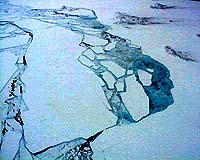
New research published in the September 17 issue of the journal Science sheds light on the evolution of Earth's climate system by identifying changes in temperature, ocean circulation, and global carbon cycling associated with the rapid growth of Antarctic ice sheets approximately 14 million years ago. By studying chemical changes in deep sea sediments, scientists at the University of California, Santa Barbara discovered that high-latitude Southern Ocean cooling helped to trigger this major expansion of Antarctic ice sheets, which have since become a permanent feature of the global climate system. These results document ice sheet history and supply crucial insight into the dynamics of the global climate system. Scientists have long recognized that the Southern Ocean and the development of Antarctic ice sheets play a major role in the evolution of Earth's present climate system. Only now have researchers been able to obtain a clearer picture of the relationship between high-latitude temperatures, global carbon cycling and the size of Antarctic ice sheets. Southern Ocean temperature data exhibits a rapid 7 degree cooling of surface waters around 14 million years ago and suggests a strengthening of the Antarctic Circumpolar Current in response to changes in the geometry of Earth's orbits. As a result, Antarctica became increasingly isolated from tropical heat and moisture sources. Records of Antarctic ice volume indicate that following this cooling ice sheets expanded rapidly to near present-day size, which suggests that changes in the Southern Ocean directly influence the size of the Antarctic ice sheet. Related Links Science SpaceDaily Search SpaceDaily Subscribe To SpaceDaily Express  Dispute Over Life In Antarctic Lake
 Lake Vostok (SPX) Aug 05, 2004
Controversy has erupted over Lake Vostok, one of Earth's last unexplored frontiers, which lies deep under the Antarctic ice. Last week a team of Russian and French scientists claimed the lake is sterile. But American scientists insist that it is a potential source of undiscovered life forms, and are worried that Russian plans to drill right through the ice will contaminate it.
|
|
| |||||||||
| The content herein, unless otherwise known to be public domain, are Copyright 1995-2016 - Space Media Network. All websites are published in Australia and are solely subject to Australian law and governed by Fair Use principals for news reporting and research purposes. AFP, UPI and IANS news wire stories are copyright Agence France-Presse, United Press International and Indo-Asia News Service. ESA news reports are copyright European Space Agency. All NASA sourced material is public domain. Additional copyrights may apply in whole or part to other bona fide parties. Advertising does not imply endorsement, agreement or approval of any opinions, statements or information provided by Space Media Network on any Web page published or hosted by Space Media Network. Privacy Statement All images and articles appearing on Space Media Network have been edited or digitally altered in some way. Any requests to remove copyright material will be acted upon in a timely and appropriate manner. Any attempt to extort money from Space Media Network will be ignored and reported to Australian Law Enforcement Agencies as a potential case of financial fraud involving the use of a telephonic carriage device or postal service. |